
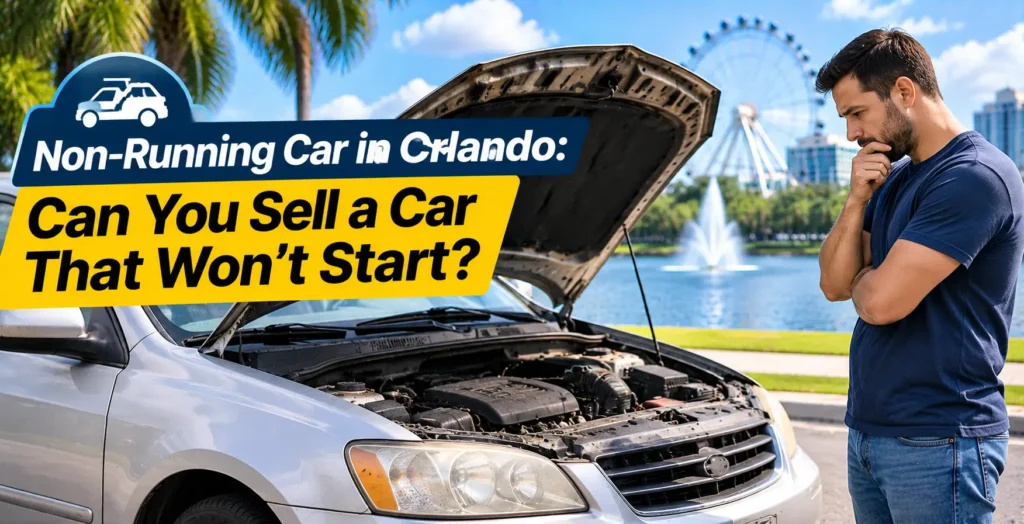
Yes, you can sell a car that won’t start in Florida. A dead car still holds value in its metal, its parts and its weight. A local non running car buyer brings the tow truck, so the car does not need to run, roll or pass any test. This guide shows what to check first, what a buyer looks at and which Florida steps to follow. It is general information, not repair or legal advice.
We are Junk Cars Removal Orlando, a local company that buys cars that no longer run. We take calls Monday to Saturday, 7am to 7pm.
What Should You Know Before You Sell?
Start with these five quick answers:
- Can I sell it? Yes. Buyers pay for scrap weight and usable parts, not for a running engine.
- Does it need to move? No. The buyer sends a tow truck or flatbed.
- Should I fix it first? Only if the repair costs far less than the car is worth.
- What do I need? Usually the title, a photo ID and any keys you have.
- What can go wrong? An open lien, a missing title and storage fees at a tow yard.
Why Won’t Your Car Start?
You do not need the exact cause to sell. A quick look still helps you choose between a repair and a sale. A mechanic should confirm any diagnosis. This table lists common signs.
| What you notice | Common cause | What it means for a sale |
|---|---|---|
| Clicking sound, dim lights | Weak or dead battery | Often a small fix. Try a jump or a new battery first. |
| One loud click, bright lights | Starter or bad connection | Repair cost varies. Get a quote before you decide. |
| Engine turns but never fires | Fuel, spark or sensor problem | Can be minor or major. Ask a mechanic. |
| No sound and no lights | Dead battery, loose cable or wiring fault | Check the cables, then call a mechanic. |
| Car sat for months | Old fuel, flat battery, flat tires | Often fixable, but the bill can pass the car’s value. |
| Water reached the cabin or engine | Flood damage | Do not try to start it. Tell the buyer right away. |
Should You Try to Start a Flood-Damaged Car?
No. Heavy rain and storms can flood a car in Florida. Turning the key on a wet engine can add damage. If an insurer totals the car, the title can carry a brand, and FLHSMV lists brands such as Rebuildable Flood. Our guide to selling a totaled car in Florida explains how payouts and titles work.
Should You Repair It or Sell It?
Compare the repair quote with what the car would be worth if it ran. If the two numbers are close, a sale is usually the cleaner choice. Here is an example with made-up numbers. A car would sell for $3,000 if it ran. The repair quote is $2,400. After you pay, you still own an older car with other worn parts.
Repair First If
- The fix is a battery, a cable or another small part.
- The car is otherwise sound, and you plan to keep driving it.
- The quote is far below the car’s running value.
Sell As-Is If
- The quote is close to the car’s value.
- The engine, transmission or frame is damaged.
- The car sat for a long time and needs several repairs.
- The car is old, and the repair would not pay for itself.
What Are Your Options for a Car That Won’t Start?
| Option | Best for | Trade-off |
|---|---|---|
| Sell to a local buyer | Fast removal of a car that no longer runs | The offer reflects scrap and parts value. |
| Jump or replace the battery, then sell | A car with only a weak battery | You spend money first, and the car may still not start. |
| Repair it, then sell | Small repairs on a newer car | Repair bills can pass the car’s value. |
| Sell it for parts | Owners with time and tools | It is slow, and the leftover shell still needs removal. |
| Trade it in at a dealer | Buying another car at the same dealer | Offers are often low, and towing may cost extra. |
| Donate it | Giving the car to a charity | No cash, and pickup timing varies. |
What Is a Non-Running Car Worth to a Buyer?
Buyers pay for what they can recover from the car. A car that won’t start is not worthless. These factors matter most:
- Weight and size: heavier cars hold more scrap metal.
- Complete or stripped: a car with its engine, transmission and doors is worth more than a bare shell.
- Catalytic converter: a car that still has its own usually brings a higher offer.
- Wheels and tires: a car that rolls is easier to load.
- Make, model and year: popular models have parts in demand.
- Location: a driveway is easier than a tight lot or a car boxed in by others.
For more on pricing, read our guide on how much your junk car is worth in Orlando. Be careful with anyone who quotes a fixed price sight unseen.
What Paperwork Do You Need to Sell a Non-Running Car?
Florida uses the same paperwork for a car that runs and one that does not. Check the latest steps on the FLHSMV selling page before you sign.
- Title: fill in the seller section with the buyer’s name and address, the odometer reading, the price and the sale date.
- Photo ID: the buyer will ask to see it.
- Lien release: if a lender held a loan, get proof it was paid off.
- Bill of sale: write down the VIN, the price, the date and both full names.
- Notice of sale: file Form HSMV 82050. County tax collectors list a 30-day window, so file soon.
- Plate: it stays with you, not the car. Ask your tax collector whether to keep it or surrender it.
- Keys: hand over every key you have, and tell the buyer if one is missing.
How Do You Prepare the Car for Pickup?
- Remove personal items, toll tags and loose papers.
- Photograph every side, the VIN and the dashboard.
- Tell the buyer if the wheels, steering or gear shifter are stuck. This changes how the driver loads the car.
- Mention flat tires, missing parts or cars parked behind yours.
- Keep your insurance active until the car leaves the property.
How Does a Buyer Move a Car That Won’t Roll?
A driver cannot drive away a car that won’t start, so the crew plans the tow before it arrives. Most non-running cars go onto a flatbed or a wheel-lift truck. A car with locked wheels, flat tires or low ground clearance may need extra tools and more time.
These details help the driver bring the right equipment:
- Where the car sits: driveway, street, garage, back yard or a gated lot.
- Whether the wheels turn and the steering moves.
- Whether the car is in park and the shifter is stuck.
- Gate codes, tight turns or low branches near the car.
- Whether another car blocks the way out.
Tell the buyer about any of these on the first call. A correct description helps the offer hold up on pickup day.
How Do You Sell a Car That Won’t Start, Step by Step?
- Write down the year, make, model, mileage and what happens when you turn the key.
- Take photos of every side, the VIN and any damage.
- Check the title for a lender’s name. If a loan is open, ask for the payoff amount.
- Get a repair quote if you are unsure, and compare it with the car’s running value.
- Collect written quotes from at least two buyers. Ask what each one includes, such as towing.
- Confirm the pickup time and where the car sits. Hand over the signed title only once payment is confirmed.
- Remove your plate, file the notice of sale and update your insurance after the car leaves.
What Should You Watch Out For?
- Storage fees that grow each day if the car sits at a tow yard. Ask who pays.
- A quote that never asks a single question about the car.
- A driver who lowers the offer at pickup for reasons you never heard.
- A towing fee hidden inside the final number. Ask for the towing details in writing.
- A blank title or form that you are asked to sign early.
- A sale before you check for a lien.
What Happens When You Call Us About a Car That Won’t Start?
Call (321) 358-8850, or send a few photos and the car’s details through our site. We ask about the year, make and model, what the car does when you turn the key, and where it sits. We confirm the offer and the towing details with you before the truck arrives. Pickup timing depends on our schedule and your location.
We pick up non-running cars across Greater Orlando, from Sanford to Winter Park.
Want to see the full service area? Read about junk car removal in Orlando, or call (321) 358-8850 with your car’s details.
What Should a Good Offer Include?
- A written quote before pickup
- The towing details in plain words
- How and when you get paid
- No up-front fees or deposits
- A business with a local phone number and an address you can verify
Frequently Asked Questions About Selling a Car That Won’t Start
Can I sell a car that won’t start in Florida?
Yes. Buyers pay for scrap weight and usable parts, so the car does not need to run. Share the year, make, model and what happens when you turn the key.
Do I need to fix the car before I sell it?
Usually not. Repair it only if the cost is far below the car’s running value. If the quote is close to that value, selling as-is often costs you less.
How much can I get for a car that does not start?
It depends on weight, which parts are still on the car, the scrap market and where the car sits. No buyer can give a fair number until they know the car’s condition. Be wary of any fixed price offered before anyone asks about the car.
Can I sell a non-running car without a title in Florida?
Buyers usually ask for the title because it proves you own the car. If yours is lost, start with a duplicate from FLHSMV. Our guide on selling a junk car without a title in Florida covers the common cases.
Who pays to tow a car that won’t start?
It depends on the buyer. Ask for the towing details in writing before you agree, and check that the fee is not hidden inside a lower offer.
What if my car has sat for years?
It can still be sold. Tell the buyer how long it has sat, whether the tires are flat and whether the wheels roll. Those details help the driver bring the right equipment.
Can I sell a flood-damaged car?
Often yes. Do not try to start it, and tell the buyer about the flood on the first call. The title may carry a brand if an insurer totaled the car, so mention that too.
What do I do with my plate and insurance after the sale?
Take your plate off before the car is towed, since in Florida it belongs to you and not the vehicle. Ask your county tax collector whether to keep it for another car or surrender it. Leave your insurance active until the car has left, then update your policy.
One Response