
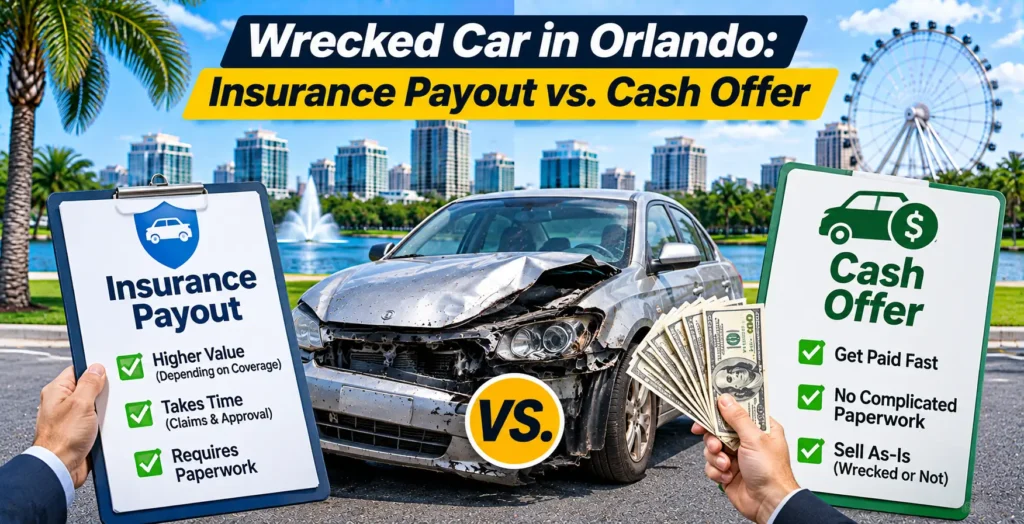
After a crash, you usually have two paths. You can take what your insurer offers, or you can sell the car for cash to a local wrecked car buyer. The right choice depends on whether you have a claim, what the car is worth and what you still owe. This guide explains how each path works in Florida, which paperwork you need and what to check before you sign. It is general information, not insurance or legal advice.
We are Junk Cars Removal Orlando, a local, licensed and insured company. Our founder has 15+ years in the junk vehicle industry. We buy damaged cars in Orlando and nearby towns, Monday to Saturday, 7am to 7pm.
What Should You Know Before You Choose?
Start with these five quick answers:
- Is my car totaled? On an insured car, Florida treats it as a total loss when the insurer pays to replace it.
- Who gets paid first? If you have a car loan, the lender is paid first.
- Can I sell it for cash? Often yes, if there is no open claim or you keep the car after a claim. Ask your insurer first.
- What does a buyer pay for? Scrap weight, the parts that survived and the condition of the car.
- How fast is each path? A cash sale can take days. A claim follows your insurer’s timeline.
What Does “Totaled” Mean in Florida?
FLHSMV says an insured vehicle is a total loss when the insurer pays the owner to replace it. For a car with no insurance payout, the test is repair cost. The car is a total loss when repair or rebuild costs reach 80 percent or more of its replacement cost. You can read both rules in the FLHSMV total loss procedure. On a claim, your insurer makes the call, so ask for the written estimate and the valuation.
Why Can a Car That Looks Fine Be Totaled?
Cost matters more than looks. Airbag replacement, a bent frame and hidden damage behind the bumper add up fast. An older car with a lower value can be totaled by a repair bill that would not total a newer car.
What Are Your Options After an Accident in Orlando?
You have more than two choices. This table compares the common ones.
| Option | Best for | Trade-off |
|---|---|---|
| Take the insurance payout | Open claims with coverage | The insurer usually takes the car, and the payout follows its valuation. |
| Keep the car after a total loss | Owners who want to repair or sell it themselves | The payout drops by the salvage value, and the title is branded. |
| Sell to a local buyer | No claim, a low payout, or a car you want gone | The offer reflects scrap and parts value, not repaired value. |
| Repair it | Damage that costs far less than the car is worth | Repair bills can pass the car’s value fast. |
| Donate it | Giving the car to a charity | No cash on the spot, and pickup can take time. |
How Does an Insurance Payout Work?
On a covered total loss, most insurers pay the car’s actual cash value, which is what it was worth just before the crash. They subtract your deductible. If you still owe money, the lender is paid first, and you owe any difference. Gap coverage can pay that difference, but only if you bought it before the accident.
What If You Owe More Than the Car Is Worth?
Here is a simple example with made-up numbers. A car is worth $8,000 before the crash, and you owe $10,000. The insurer pays the lender about $8,000 before any deductible, and you still owe about $2,000. Check your loan papers for gap coverage before you accept an offer.
How Do You Challenge a Low Offer?
- Read the valuation report for mistakes in trim, mileage or options.
- Collect listings for similar cars from local sellers.
- Keep receipts for new tires, a new battery or other recent work.
- Ask your insurer in writing how it reached the number.
- If you still disagree, ask about your policy’s appraisal process or contact your state insurance regulator.
Can You Sell a Totaled Car in Florida for Cash?
Sometimes. A cash sale makes sense in a few common cases:
- There is no claim, such as when you have no collision coverage or the damage costs less than your deductible.
- The payout is too low, and you decide to keep the car.
- The claim is settled, and the insurer has released the car to you.
- The car is old, and its main value is in parts and scrap.
If a claim is open, talk to your insurer before you sell or move the car. The insurer may need to inspect it first, and an early sale can slow the claim. A buyer can price the car while you wait, so you have a number to compare.
What Happens If You Keep a Totaled Car?
If you ask to keep a car the insurer has totaled, the payout is usually reduced by the car’s salvage value. FLHSMV says the owner assigns the title to the insurer. The insurer gets a salvage title in its name and then reassigns it to you. After that, the title carries a brand, such as Rebuildable.
Many wrecked car buyers still take branded-title cars, but the offer reflects the brand. Tell the buyer about it on the first call.
What Is a Wrecked Car Worth to a Buyer?
A buyer prices what can be recovered from the car. These factors matter most:
- Weight and size: heavier cars hold more scrap metal.
- Where the damage is: a rear hit may leave a sound engine, while a front hit may not.
- Parts that survived: doors, seats, wheels and tires can be sold if they are intact.
- Catalytic converter: an intact one usually adds value.
- Scrap market: metal prices change from month to month.
- Access: a car in a ditch or a tight lot costs more to move.
For a wider look at pricing, read our guide on how much your junk car is worth in Orlando. No honest buyer can name a number without seeing the damage.
What Paperwork Do You Need to Sell a Wrecked Car in Florida?
Most sales need the Florida title in your name, a photo ID and a bill of sale. Confirm the current steps with FLHSMV before you sign.
- Title: sign the seller section. A salvage or branded title works the same way.
- Lien release: if a lender held a loan on the car, get proof it was paid off.
- Bill of sale: list the date, price, VIN and both names.
- Notice of sale: Florida asks sellers to file Form HSMV 82050 within 30 days.
- Plates: they stay with you, not the car.
- Insurance: keep your coverage active until the car leaves your property.
What Should You Watch Out For After a Crash?
- Storage and tow fees that grow each day at a tow yard. Ask who pays and how soon the car must move.
- Personal items and toll tags left inside the car.
- Signing a release or a title before the payment is confirmed.
- Canceling your insurance before the claim closes or the car is gone.
- Skipping photos. Take pictures of the damage and the VIN before anyone moves the car.
- Hiding a lien or a missing part, since a buyer who finds it at pickup may change the offer.
How Do You Sell a Wrecked Car, Step by Step?
- Take photos of the damage and the VIN. Keep the crash report number if you have one.
- Call your insurer and report the claim if you have coverage. Ask whether the car must be inspected first.
- Ask for the valuation in writing, and compare it with local listings.
- Gather your title, photo ID, lien papers and keys.
- Ask two or three buyers for a written quote. Compare what each includes, such as towing.
- Confirm the pickup. Sign the title and bill of sale only after payment is confirmed.
- Remove your plates, file the notice of sale and tell your insurer the car is gone.
A cash sale often takes days. A claim follows your insurer’s timeline.
What Happens When You Call Us About a Wrecked Car?
Call (321) 358-8850 or send photos and details online. We ask about the year, make, model, the damage and where the car sits. We confirm the towing details with you before we arrive. Many pickups happen the same day, depending on the schedule and the location. The crew loads the car and pays you in cash on the spot.
How Do You Spot a Trustworthy Buyer in Orlando?
A trustworthy buyer gives a written quote, explains every fee and has a real local presence. Some websites sell your phone number to lead brokers, so read the fine print before you submit a form. These lead brokers may not own a tow truck.
- A written quote before pickup
- No up-front fees or deposits
- An offer that holds at pickup, unless the car differs from what you described
- A local phone number and a real business address
- Reviews that describe real pickups
What Are the Red Flags?
- A flat price quoted before anyone asks about the damage
- Pressure to say yes before you talk to your insurer
- A price that drops once the driver arrives
- A request to sign a blank title or form
Our team serves Greater Orlando, including Oviedo, Winter Park and Sanford.
Ready to compare offers? Call (321) 358-8850 with your car’s details, or see how to sell your junk car in Orlando.
Frequently Asked Questions About Selling a Wrecked Car
Can I sell a wrecked car instead of taking the insurance payout?
Sometimes. If your insurer is paying to replace the car, it usually takes the car. If there is no claim, or you keep the car after a total loss, you can sell it. Ask your insurer before you decide.
Will selling my car affect my insurance claim?
It can. An open claim may need an inspection, and an early sale can slow it down. Check with your insurer before you sell, move or scrap the car. We do not give insurance advice.
How much is a wrecked car worth?
It depends on weight, the damage, the parts that survived and the scrap market. A buyer cannot give a fair number without details, so share the year, make, model and photos. Be wary of anyone who promises a fixed price without seeing the car.
Can I sell a wrecked car without a title in Florida?
A title makes the sale simple, and most buyers ask for it. If the title is lost, ask FLHSMV for a duplicate before you list the car. Our guide on selling a junk car without a title in Florida covers the common cases.
What if the car is still financed?
The lender holds a claim on the car. Ask for a payoff amount and a lien release, and tell the buyer about the loan on the first call so the quote and the paperwork match.
Should I repair my wrecked car or sell it?
Repair it only if the repair costs far less than the car is worth and the frame is sound. If the estimate is close to the car’s value, a sale is often the cleaner choice.
Can I keep a totaled car in Florida?
Yes. The payout drops by the salvage value, and the insurer handles the salvage title paperwork. FLHSMV says the title is then reassigned to you. Repairs and inspections are needed before the car can be driven again, so ask FLHSMV or your tax collector for the current steps.
What happens to my plates and insurance after I sell?
In Florida, plates stay with you, not the car. Remove them before pickup. Keep your insurance active until the car leaves, then follow FLHSMV’s current steps for the notice of sale.
One Response